
Extracting contract metadata, the structured data hidden inside legal agreements is often more challenging than it seems.
Traditional manual methods require opening each contract, scanning through the document, and copying key fields into tools like Excel. This makes it slow, expensive, and prone to error for teams trying to extract metadata from contracts at any meaningful scale. And yet, most legal and procurement teams still rely on some version of this process today either fully manual or patched together with tools that weren’t built for contract-scale work.
Today, organizations need faster, more accurate ways to extract metadata from contracts to improve compliance, reporting, and decision-making. But picking the right method requires understanding what you’re actually dealing with: the volume, the document quality, the accuracy requirements, and what you plan to do with the data once it’s extracted.
This guide walks through all of it what contract metadata is, why getting it wrong is costly, and which extraction approach actually makes sense for enterprise-scale work.
What Does It Mean to Extract Metadata from Contracts?
Contract metadata extraction is the process of identifying and extracting structured information from legal agreements and converting it into searchable, reportable data. Rather than manually reviewing every contract, organizations extract key fields such as party names, effective dates, renewal terms, payment obligations, governing law, and liability provisions.
The extracted metadata can then be loaded into a CLM system, contract repository, spreadsheet, or reporting platform to improve contract visibility, compliance monitoring, and decision-making.
What Is Contract Metadata?
Contract metadata refers to structured attributes and values extracted from contracts that help organize, track, and analyze agreements. These metadata elements vary by contract type but typically include:
Core identification fields:
- Contract name and unique ID
- Contract type (MSA, NDA, SOW, lease, etc.)
- Parties involved (company names, counterparty, signatories)
- Effective date, expiration date, and notice periods
Financial and commercial fields:
- Contract value and payment terms
- Pricing escalation clauses
- Liability caps and indemnification limits
- Penalty or liquidated damages clauses
Operational and risk fields:
- Renewal terms (auto-renew vs. manual)
- Termination rights and conditions
- Governing law and jurisdiction
- Confidentiality and non-disclosure terms
- Dispute resolution process
- Obligation milestones and deliverable dates
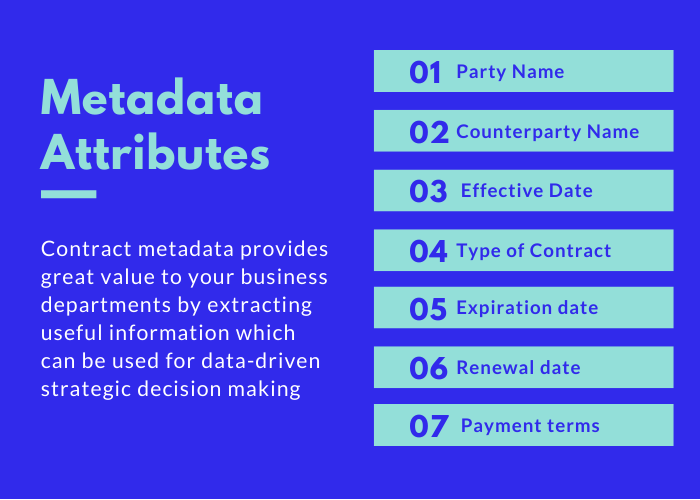
These are common starting points, not a ceiling. Depending on contract type and business objective, organizations may extract dozens or even hundreds of metadata fields per agreement. Some CLM migrations require only 20–30 key fields; compliance reviews and due diligence projects routinely require 100+ metadata elements from each document. A pharmaceutical company prioritizes regulatory compliance clauses; a logistics firm cares more about service levels and liability. Knowing your required field set before you start is half the battle and the right extraction partner should be able to accommodate whatever that set turns out to be.
Capturing these fields accurately is essential for contract lifecycle management (CLM), compliance, and risk management.
One thing worth noting: the specific fields you need will depend on your industry and the types of contracts you manage. A pharmaceutical company prioritizes regulatory compliance clauses; a logistics firm cares more about service levels and liability. Knowing your required field set before you start extraction is half the battle
Why Manual Metadata Extraction Is Inefficient
Time studies show that extracting just one attribute manually takes around 2 minutes. With an average of 30 metadata elements per contract, that’s about one hour per document.
Consider this at scale:
- 10,000 contracts × 30 metadata fields = 5,000 person-hours
- Factor in quality control, OCR scanning, document organization, and validation and the effort jumps to 8,000+ person-hours
- At 7 productive hours a day, 19 working days a month, a team of five would spend approximately one full year on this task alone
And those numbers assume the contracts are clean, digital, and reasonably well-organized. In reality, many organizations are dealing with scanned PDFs, inconsistent formatting, missing pages, and contracts spread across dozens of folders, inboxes, and shared drives. Each of those complications adds time, and with manual extraction, every hour of extra complexity hits directly in headcount cost.
There’s also the accuracy problem. Manual extraction introduces inconsistency across reviewers, one person might record “30 days written notice,” another might just put “30 days.” Over thousands of contracts, those small variations make reporting unreliable and analytics nearly impossible.
How to Extract Metadata From Contracts
Organizations looking to extract metadata from contracts often focus first on the technology. In reality, successful metadata extraction begins with understanding what information needs to be captured and how that information will ultimately be used.
Most metadata extraction projects follow a similar workflow:
- Identify the metadata fields that need to be captured
- Gather and organize contract documents
- Remove duplicates, drafts, and non-contract files
- Extract metadata using manual, automated, or hybrid methods
- Validate extracted information for accuracy
- Load the data into a CLM, repository, or reporting platform
One of the biggest mistakes organizations make is assuming they need to extract every possible attribute from every contract.
In practice, the right metadata set varies by organization, contract type, and business objective. Companies preparing for CLM implementations often start with a core set of high-value attributes and expand over time.
For a deeper discussion on selecting the right metadata fields during a migration project, see What Attributes Do I Extract and Ingest Into a CLM During the Legacy Contract Migration Process?
What Good Contract Metadata Actually Looks Like
Before comparing extraction methods, it helps to understand what the output should be.
When contract metadata is properly extracted, each agreement becomes a row in a structured dataset, something your legal ops, procurement, or finance team can filter, sort, and report on without opening a single PDF. You should be able to answer questions like:
- Which of our vendor contracts auto-renew in the next 90 days?
- How many agreements have uncapped liability?
- What’s our total annual spend under contracts expiring before Q4?
- Which contracts require 60-day notice for termination?
If you’re still answering those questions by hunting through files manually, your metadata extraction process isn’t working regardless of what method you’re using.
Accuracy matters enormously here. A missed auto-renewal clause can mean being locked into a vendor for another year. A misread liability cap can expose a company to unexpected risk. This is why “close enough” doesn’t cut it for contract data.
Strategies of Contract Metadata Extraction
There are three common approaches to extracting metadata:
1. Fully Manual Extraction
- Involves legal professionals or contract managers manually reviewing and abstracting data.
- Cons: High risk of human error, inconsistencies across team members, slow process.
2. Fully Automated Extraction
- Uses contract analysis or AI-driven software.
- Cons: Legal language is nuanced; software may miss context or misinterpret clauses. Requires installation, training, maintenance, and ongoing quality control.
3. Hybrid Extraction (Technology-Enabled Service)
- Combines automation with human review.
- Software extracts metadata, and a trained team validates the data.
- Pros: High accuracy, scalability, and faster turnaround.
- Bonus: One vendor provides both tech and service – “one throat to choke.”
| Criteria | Manual | AI Only | Hybrid |
|---|---|---|---|
| Speed | Low | High | High |
| Accuracy | Medium | Medium-High | High |
| Scalability | Low | High | High |
| Human Validation | Yes | No | Yes |
| Setup Requirements | Low | High | Medium |
| Best For | Small portfolios | Standardized contracts | Enterprise portfolios |
While AI-only extraction can significantly reduce processing time, organizations handling thousands of contracts often require a validation layer to ensure business-critical information is captured accurately.
Why hybrid works:
- Automation handles the volume and speed
- Human review catches what the software misses context-dependent clauses, unusual language, poor scan quality, contradictory terms
- One vendor owns both the technology and the outcome, so there’s clear accountability
- Scales to any volume without sacrificing accuracy
We’ve run this process across tens of thousands of contracts including a financial services engagement where we extracted over 80,000 contract attributes across 4,000+ agreements in 90 days, and a security sector project where we recovered usable metadata from a degraded legacy archive that standard OCR tools couldn’t reliably read. In both cases, fully automated extraction alone would have produced unreliable results. The human validation layer was what made the output trustworthy.
Choosing the Right Approach
While automation sounds attractive, the quality and accuracy of extracted metadata can make or break your contract analytics, compliance initiatives, and CLM migration efforts.
A hybrid approach provides the best of both worlds: speed from automation and accuracy from human expertise.
Before embarking on a metadata extraction project, evaluate:
- Volume and complexity of your contracts
- Required turnaround time
- Regulatory and compliance risks
- Availability of internal resources
Organizations with large contract repositories often discover that extracting every document and every attribute is neither practical nor necessary. Prioritizing contracts, contract types, and metadata fields can significantly reduce project cost and complexity.
For more on how organizations approach large-scale migration and extraction projects involving hundreds of thousands of documents, see I Have 300,000 Documents – What Do I Migrate Into a New CLM System?
📊 Market Insight
The OCR market is projected to hit $32.9B by 2030 , and CLM software is valued at $1.74B in 2024 with strong growth ahead.These numbers highlight how much businesses are prioritizing contract data automation and underscore why efficient metadata extraction strategies are essential today.
Final Thoughts
Extracting metadata from contracts is a strategic task that can streamline contract management, improve visibility, reduce risk, and support business growth.
While manual extraction struggles to scale and fully automated approaches can introduce accuracy concerns, a hybrid approach offers the most reliable, scalable, and cost-effective path forward.
Brightleaf operates as an ISO 27001 certified service provider, which matters when you’re sharing confidential legal agreements with an external vendor. Enterprise-grade data security is built into the process, not bolted on afterward.
Organizations preparing for CLM implementations often combine metadata extraction with broader initiatives such as Contract Migration, and Contract Data Extraction, to maximize the value of their contract data.
Looking to extract metadata from contracts without the hassle? Reach out to us to learn how Brightleaf’s technology-enabled services can help.