
Key takeaway:
Contract migration is a five-stage process – scan, OCR, extract, upload, ingest but the software and steps matter less than the accuracy of the extracted data. A migration that skips verification, excludes expired contracts, or fails to link masters to amendments will produce a CLM with unreliable reporting, regardless of which stages were technically completed.
What is contract migration?
Contract migration is the structured process of moving contract documents and data from legacy systems, paper files, shared drives, or outdated repositories into a modern CLM (contract lifecycle management) system. The term is sometimes used loosely to mean simply getting contracts out of an old system or file folders, but the process itself follows five defined stages: scanning paper documents into digital files, OCR to convert images into searchable text, metadata extraction to pull out attributes like parties, terms, and obligations, uploading the structured data into the CLM, and ingesting the associated files.
Migration should include historical and expired contracts, not just new agreements going forward, since old contracts often still carry enforceable obligations. When the process includes this structured metadata layer rather than just the documents themselves, it’s often called contract data migration and it’s this data layer, not the document transfer, that determines whether the CLM produces reliable reporting.
Why Contract Migration Is Worth Getting Right
Most organizations don’t realize the full cost of unmanaged legacy contracts until something goes wrong: a renewal auto-triggers that no one expected, an obligation goes unmet, or a funding round surfaces contracts that haven’t been touched in years. The problem is not that contracts are complicated, it is that their data is invisible until someone needs it.
World Commerce & Contracting estimates that poor contract management is linked to as much as 9.2% of annual revenue loss. A 2024 Deloitte study, drawing on responses from more than 1,000 business leaders across 10 countries, found that ineffective agreement management costs organizations nearly $2 trillion in annual global economic value, a figure projected to reach $2.3 trillion by 2030. The difference between organizations on the right side of those numbers and the wrong side comes down to how well contracts are managed and that starts with migration.
Migrating your contracts into a CLM changes that. Here is what a well-executed migration actually delivers:
- A complete picture of your obligations. Legacy contracts often contain commitments that extend well past their expiration date. Payment obligations, indemnity terms, non-compete clauses, and evergreen renewal provisions do not disappear when a contract ages. Migration surfaces these so they can be tracked and managed, rather than discovered during a dispute.
- Historical data that makes your CLM useful from day one. If you deploy a CLM and only capture contracts going forward, your reporting is incomplete by definition. You cannot benchmark terms, spot renewal patterns, or forecast liabilities without historical data. Migration fills that gap.
- Leverage in future negotiations. Knowing what you have agreed to previously – rates, liability caps, payment terms, service levels which gives your legal and procurement teams a factual baseline at the negotiating table. That intelligence lives in your legacy contracts. Without migration, it stays buried there.
- Protection against the contracts you have forgotten about. Auto-renewal clauses are one of the most common sources of unbudgeted spend in organizations. A contract that renews automatically at last year’s rate, without anyone noticing, is a failure of visibility. Migration that is done accurately eliminates this category of risk entirely.
- A CLM that actually earns its ROI. Organizations frequently implement CLM systems and then struggle to justify the investment because adoption is low and reporting is unreliable. The root cause, almost always, is that legacy contracts were never properly migrated. The CLM is only as useful as the data inside it.
The Contract Migration Process
Contract migration follows a defined sequence of stages. Skipping or shortcutting any stage creates compounding problems downstream.
- Scan – Scan the documents from paper to a file on a computer. This will yield an image-based file, in either .TIF, .GIF, .JPG, .BMP, or .PDF. The. PDF would be an “image-based” PDF file. i.e. you cannot search for words within the file because it is a digital picture (image) of the document.
- OCR – OCR is the acronym for Optical Character Recognition, converting the images into text is the process termed OCR. This converts the images into text using off-the-shelf software. There are many excellent programs that convert scanned images to text. This is a mature software solution that has been in service for many years and has evolved into a highly accurate capability.
- Extract – The three-level process of data mining comprises metadata extraction, review, and vetting:
- Extract the meta-data elements, aka. Attributes. From each contract, extract the items that you would like to track and query/report on. Such as Counter Party name(s), the term(s), termination, jurisdiction(s), full clauses such as indemnity clause, or even obligations that are usually strewn across the contracts and their addenda. Using software makes this process much more accurate.
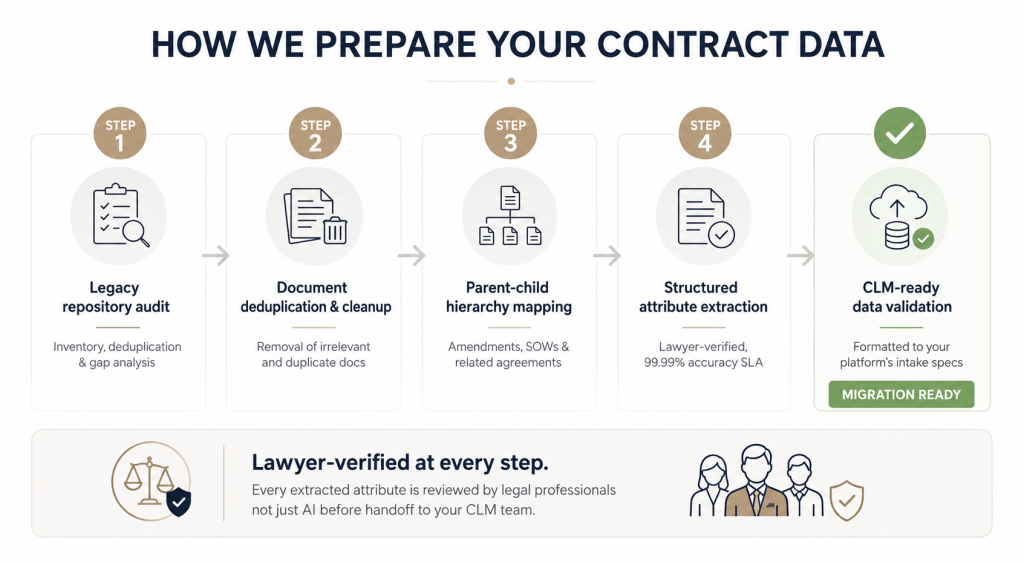
- Human oversight is essential to ensure quality. A team of lawyers should be used to check what the software extracts, and fix/fill-in-the-blanks in where the software couldn’t (maybe because of some OCR read errors or hand-written attributes such as signatures, dates, etc.)
- The output should always be verified, regardless of whether it is done in-house or outsourced. The process of verifications should initially include checking everything and then spot-checking the most important elements.
- Upload – The final output is a database file, often as a . CSV or an. XLS file. This file is then mapped into a CLM system (or another database program) so that the file itself as well as the extracted attributes are uploaded into the system in the file format structure that will support them. This too needs to be validated with a small sample test file to ensure accurate uploads.
- Ingest (Repositories/Drives/Folders) – One can choose to migrate the data directly into CLM through their document repositories, shared drives, or folders if the metadata elements are already available. Else, a process starting from conversion (Stage #2) will usually follow for migration.
Notes:
- Reporting and triggers for action are typically performed by the CLM system.
- It may require rerunning the above process a few times to ensure the full depth of data is extracted with complete accuracy and reliability.
Two Types of Contract Migration
Migration can be segregated into two categories:
- Document migration – The process of uploading the scanned or OCR’d copies of your contracts onto the CLM.
- Metadata extraction and migration – Key data points (also known as metadata) are extracted from the contracts and uploaded onto the CLM for review and reporting.
Most organizations need both. Which is what separates document migration from a true contract data migration process Document migration alone without structured metadata produces a searchable archive. Whereas to justify a CLM investment for reporting, and alerting the quality of metadata migration is pivotal.
How Do You Migrate Contracts from Shared Drives to a CLM?
A significant share of legacy migrations start from a shared drive rather than a filing cabinet, and that comes with its own set of problems that scanning and OCR don’t solve.
Shared drives are rarely organized around contract logic. Folder structures usually reflect whoever set them up years ago, by department, by deal, by year, sometimes with no consistent pattern at all. Locating a specific agreement often depends on someone remembering where they filed it, which becomes a real problem the moment that person leaves the company.
Duplicate files are the norm, not the exception. The same contract frequently exists as a signed PDF, an editable Word draft, and an email attachment saved by different people at different points in the deal. Carrying all of these into the CLM as if they were separate agreements is one of the fastest ways to inflate a repository with noise.
Version control creates the other recurring issue. When a contract has been amended, shared drives rarely make it obvious which file is current. That ambiguity needs to be resolved before extraction, since ingesting the wrong version means the CLM reports on outdated terms without anyone realizing it.
This is why metadata extraction matters just as much for shared-drive migrations as it does for paper archives. The documents are already digital, but digital doesn’t mean structured. Extracting standardized attributes, contract type, parties, dates, and key terms, is what turns a loosely organized folder into a repository you can actually query and report on.
What Makes Contract Migration Harder Than It Looks
Most migration discussions focus on process steps. What they underplay is the condition of the documents themselves. In our experience working across thousands of legacy contracts, the source data quality is where projects run into trouble:
- Handwritten fields. Signatures, dates, and amendments are frequently handwritten. OCR software cannot reliably read handwriting. These fields require manual review by someone who can interpret contractual context, not just transcribe characters.
- Poor scan quality. A contract scanned at low resolution, scanned sideways, or scanned from a faded photocopy produces OCR errors that look plausible but are wrong. A date reads as a different date. A party name gains a character. These errors are invisible unless someone checks the extracted value against the original.
- Masters and amendments stored separately. In most contract archives, master agreements and their amendments are separate files, often named inconsistently. Failing to link them correctly during migration means your CLM reflects the original terms rather than the currently operative ones, a meaningful legal and financial error.
- Duplicate and near-duplicate documents. Years of emailing contract drafts, creating working copies, and storing both signed and unsigned versions produces archives full of near-duplicates. Migrating all of them creates clutter; migrating the wrong version creates risk.
- Data format mismatches. Your legacy system may store dates as MM/DD/YYYY. Your CLM expects YYYY-MM-DD. Your legacy system stores party names inconsistently across records. Without normalization before ingestion, your CLM reports will be unreliable from day one.
This is why software alone accounts for only part of any reliable migration process. The problems above are not software problems, they are judgment problems that require legally trained people to identify and resolve.
What Data Cleanup Is Needed Before Migrating to a CLM?
The problems above aren’t reasons to delay migration, they’re the checklist for what needs to happen before data reaches the CLM.
Start with deduplication. Run a pass to identify and remove duplicate and near-duplicate files before extraction, not after. Migrating three copies of the same contract into a CLM doesn’t just waste storage, it produces reporting that counts the same obligation multiple times.
Separate what’s still active from what isn’t. Not every legacy document needs full metadata extraction. Contracts with no surviving obligations and no ongoing relevance can be archived at the document level, while contracts that still carry enforceable terms get the full extraction treatment. This filtering step is what keeps a migration project from ballooning in scope.
Confirm you’re working from the latest executed version of each agreement. Where a master has multiple amendments, the extraction needs to reflect current terms, not the original signing date, an issue this article already covers in detail above.
Normalize metadata before it ever reaches the CLM. Party names, date formats, and contract type labels tend to drift over years of manual filing. A counterparty might appear under four different name variations across your archive. Standardizing these before upload is what makes CLM reporting actually usable, rather than something that needs manual reconciliation every time someone runs a query.
Agree on naming and classification conventions upfront. Retrofitting a taxonomy after thousands of records are already loaded is far more expensive than defining it before the first batch goes in.
None of this is a step you complete once and forget. It’s the difference between a CLM that gives you reliable answers and one that just gives you a searchable version of the same chaos.

Whitepaper
These are not edge cases; they are the norm in legacy contract archives. AI software is a critical part of solving them, but knowing when it helps and where it falls short is what separates a clean migration from a costly re-do.
Our whitepaper When & Why: Select AI Software for Contract Metadata Extraction walks through the specific situations where AI extraction excels, where it struggles, and what to look for in any software you evaluate.
Why Accuracy Is the Only Migration Metric That Matters
It is common for migration vendors to advertise high extraction speeds, broad CLM compatibility, or AI capabilities. What is less commonly discussed is accuracy, specifically, what percentage of extracted data points are correct when checked against the source document.
The reason this matters: if 10 out of every 100 extracted data points contain errors, every report your CLM produces is built on unreliable data. Renewal alerts fire on wrong dates. Obligation tracking misses commitments. Leadership makes decisions based on figures that do not reflect reality.
The standard industry practice of spot-checking; reviewing a sample of records rather than every record is not sufficient for contract data that drives business decisions. A spot-check might validate 15 records out of 1,500. The other 1,485 remain unverified.
Frequently Asked Questions
Yes. An expired contract's stated term ending doesn't mean its obligations have. Indemnity clauses, warranty periods, confidentiality terms, and non-compete provisions frequently survive expiration and remain enforceable. Expired contracts also establish the negotiating history and precedent you'll rely on in renewals or disputes. Excluding them from migration just moves the risk from "unmanaged" to "invisible."
Master agreements and their amendments should always be linked before not after ingestion into the CLM. If they're migrated as unrelated, standalone files, your CLM will reflect the original terms rather than the currently operative ones. In practice, this means identifying every amendment tied to a master during the extraction stage, confirming the amendment chain is complete, and mapping them as a single connected record rather than separate entries.
In most cases, yes. Low CLM ROI is rarely a software problem; it's almost always a symptom of legacy contracts that were never properly migrated, or migrated with unverified data. If your CLM was deployed with only contracts going forward, its reporting is incomplete by definition — there's no historical baseline to benchmark against. A structured, accuracy-checked migration of the legacy backlog is usually what unlocks the reporting and adoption a CLM was purchased for in the first place.
Include the older ones. It's tempting to treat legacy contracts as "too difficult" and start capturing data only from today forward, but that decision quietly moves risk and opportunity out of view rather than resolving it. Older contracts carry the same attributes as new ones i.e. obligations, renewal terms, negotiated rates, and the cost of extracting their data isn't meaningfully different from extracting a new contract's. Leaving them out means your CLM can only ever show you half the picture: what's ahead, not what you've already agreed to.